A Chat with Erika Lee
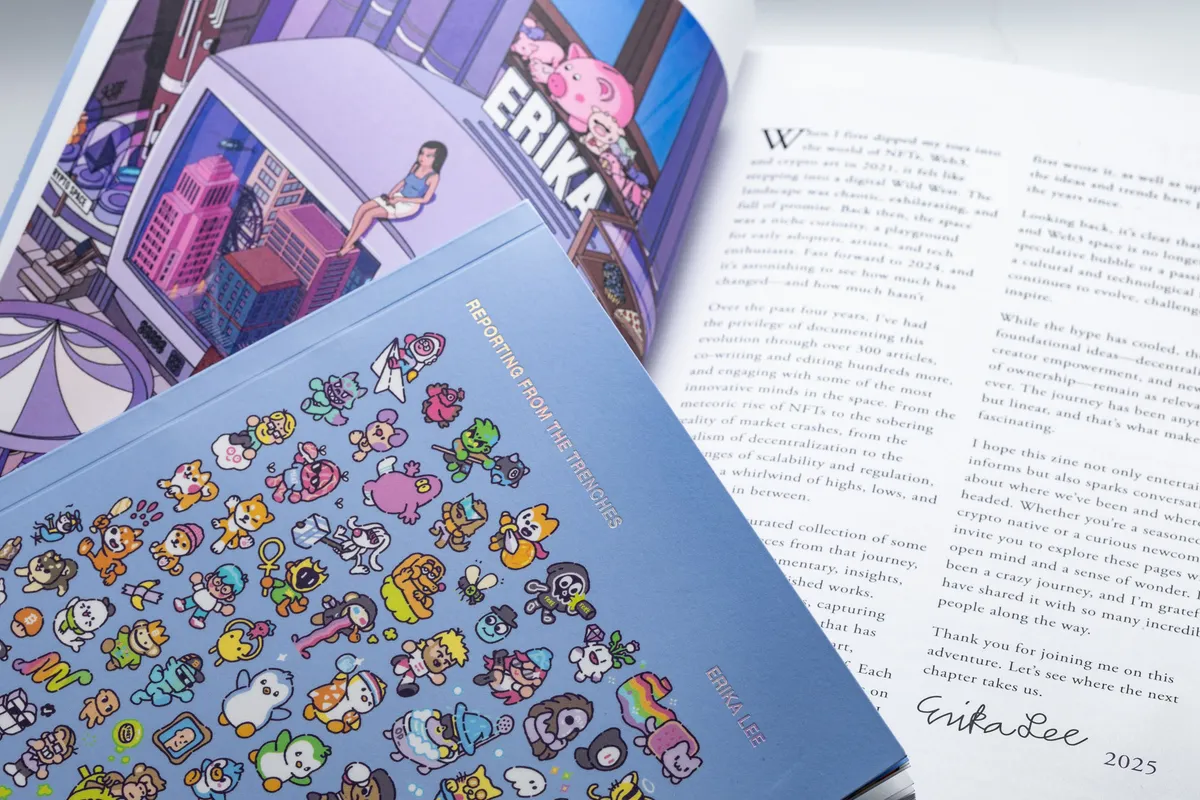
Erika Lee is a journalist who has spent the last five years documenting digital art and blockchain culture. In this conversation, we discuss her new project Reporting From the Trenches, a collection of Erika's articles from her years covering crypto and personal essays. The drop consisted of an Edition Page as well as a token gated reading experience.
In this conversation we cover her time covering the space, preserving crypto’s short memory and the importance of authentic marketing.
A chat with Erika Lee
Manifold: gm. I can’t wait to chat about Reporting From the Trenches, but first I’d love to learn about how you got involved in the space?
Erika: Before crypto, I worked in local news for five years. I've always been a journalist. I studied journalism in college, and after that, I worked at television news stations across the country as a local news reporter. I found crypto by chance - A journalist friend dropped out of his program because he found crypto and NFTs, and he was ecstatic.
He told me this was the future and I had to check it out. I set up my wallet, followed people on Twitter, and learned on my own. Then I started making friends on Twitter and joining Discord and Telegram communities.
Manifold: What was the first piece you did?
Erika: I started freelancing while still working as a reporter, interviewing artists similar to what you’re doing. It was a way for me to do journalism in the crypto space. Digital art helped me connect on a personal level. NFTs were getting popular, people were minting, and it was giving artists a way to monetize their work again. It was a way for me to talk about art and technology simultaneously.
Manifold: What has the journey been like leading up to publishing your latest project?
Erika: Even when I was younger, I wanted to make my own book. I've been writing creative short stories since I was young.
What made me want to write this book was that some of my early articles can't be found online anymore because that website shut down. It made me think about minting on the blockchain and preserving something forever. I have work in different places, so having one body of work in one place, looking back on history, and adding new stories about myself and my journey was something in the back of my mind.
Manifold: What has it been like these last few years in the space?
Erika: It's interesting to see the changes and different metas. You have to adapt to what's trending or at least attempt to understand. It's a great way to be open-minded.
Many people weren't open-minded to meme coins in the beginning, but they became impossible to ignore. In terms of ups and downs—when there are ups, they're great, and when there are downs, they don't last long. There are people who remain in the community and don't lose belief. Showing up every day during the bear market is great because you see who's committed.
Manifold: How many pieces did you include in Reporting From the Trenches?
Erika: There's no way I could have included everything—I've done hundreds of articles. I wanted to pick pieces using three criteria: I loved writing it, it did well online, or it was an important part of history. I didn't want to pick based on one criterion because the most popular pieces aren't always the most meaningful to me personally, and the most meaningful to me aren't always the most popular. I wanted a good variety.
Manifold: Which piece stands out the most?
Erika: I wrote a personal essay in the beginning about my journey in local news and how I got into crypto as an introduction. I liked being able to share my personal story because I'd been covering other people's stories for years and loved doing that. But sharing my own story and how I got started was important. That piece stands out the most because it ties everything together.
Manifold: What do you want people to take away from the book?
Erika: I want people to take away what they've been reacting with, which I'm grateful for: "I forgot about this part," or "This reminds me of something in the past," or "I feel nostalgic—it feels like reading through history."
There's so much amnesia in the space. Things that happened last month or last year are already forgotten. Being able to chronicle history, that's valuable. That's the vibe I wanted people to get from reading it.
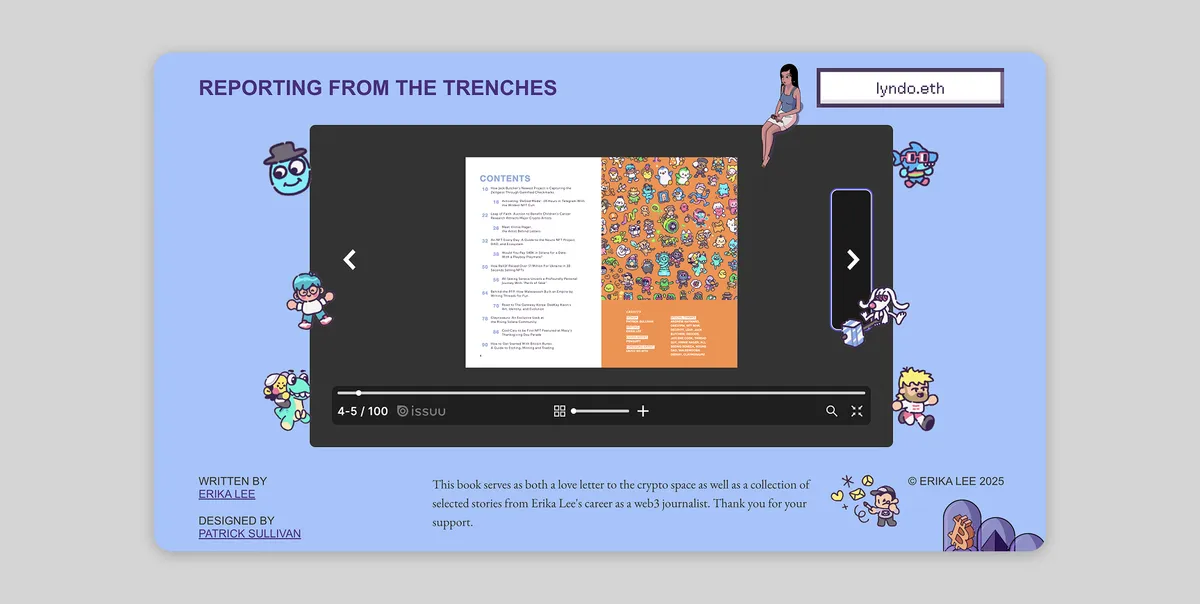
Reporting from the Trenches' Token Gated reading experience: https://erikalee.xyz/
Manifold: So you printed 50 physical copies?
Erika: I was originally supposed to print 50, and now I've done about 300 working with a publisher and I'm fulfilling it myself.
Manifold: How did you end up with Penguitt’s art for the cover?
Erika: I've always loved Penguitt's work, and I loved his yearly editions, which captured so many people and characters in the space. I told him I was doing a project and asked if I could use it. He said yes.
Manifold: The marketing for this has been great. How did you decide on your approach?
Erika: I wanted it to be as organic and authentic as possible. It wasn't specific, like "On Monday, I'm going to post this." It was more like "I am going to share this, and these are the elements I'll use." Many people are mentioned in the book, so they shared that they're in it, too.
There was always a general idea of how I wanted to market it. I made videos, recorded myself packing, shipping, and fulfilling orders. I hired a photographer to do stills of the book for marketing.
Most people who shared it have supported me over the years, so that was organic. For personal marketing, I shared the process and brought people behind the scenes. For people who subscribed to me on X, I shared what the layout looked like and asked for feedback, making it interactive.
Sharing the process makes it more personal.
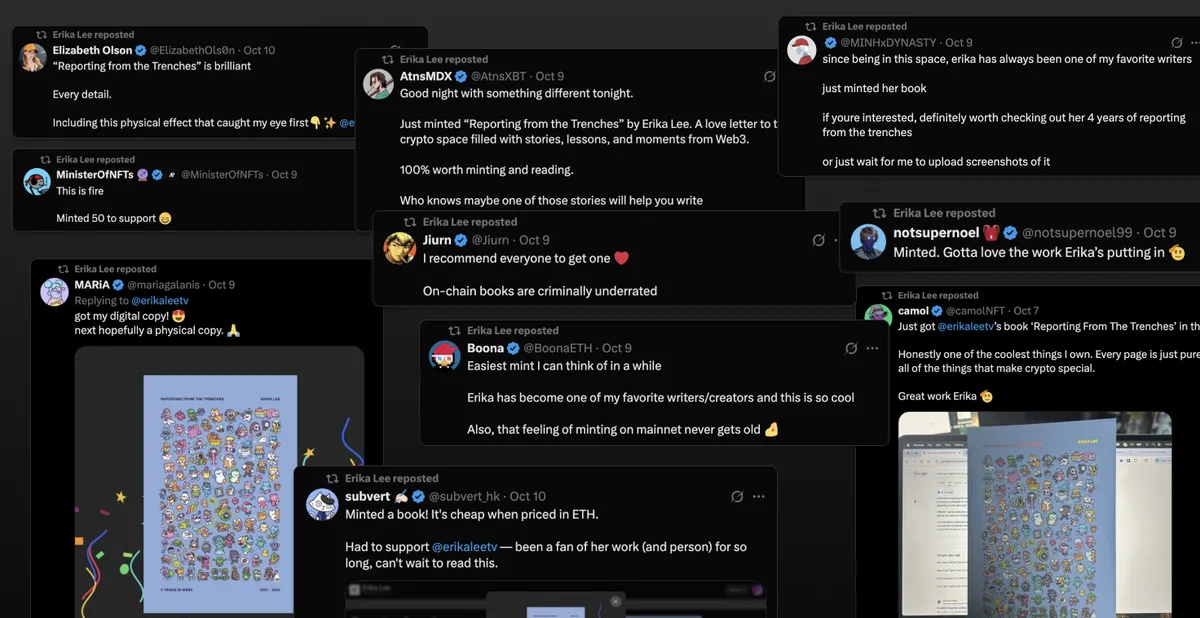
X reactions to Reporting From the Trenches
Manifold: What's next?
Erika: I'm enjoying doing my own thing, and I still write on the side. What's next is to be determined. It would be great to do another personal project like this, but not a collection—one full thing, like a novel.
I don't know if this space has the attention span for that, but it's something I've always wanted to do. I'll continue to show up in this space, create content, help other companies, and release more books down the line.
Manifold: Before we go, do you have any takeaways from your time in this space?
Erika: When I was younger, what I'm doing now didn't exist. When you're 10 years old and people ask what you want to be when you grow up, there's no way I could have known this industry existed. The same thing is happening now—people are applying for jobs and creating jobs that didn't exist a couple years ago, like prompt engineers and AI jobs. Be open-minded about what will exist in the future.
Maybe the perfect path for you isn't what you think it will be. It could be something completely different and perfect for you. Don't worry about the future as much as being authentic to yourself and your mission. Things will work out on their own.